
FikarFix...
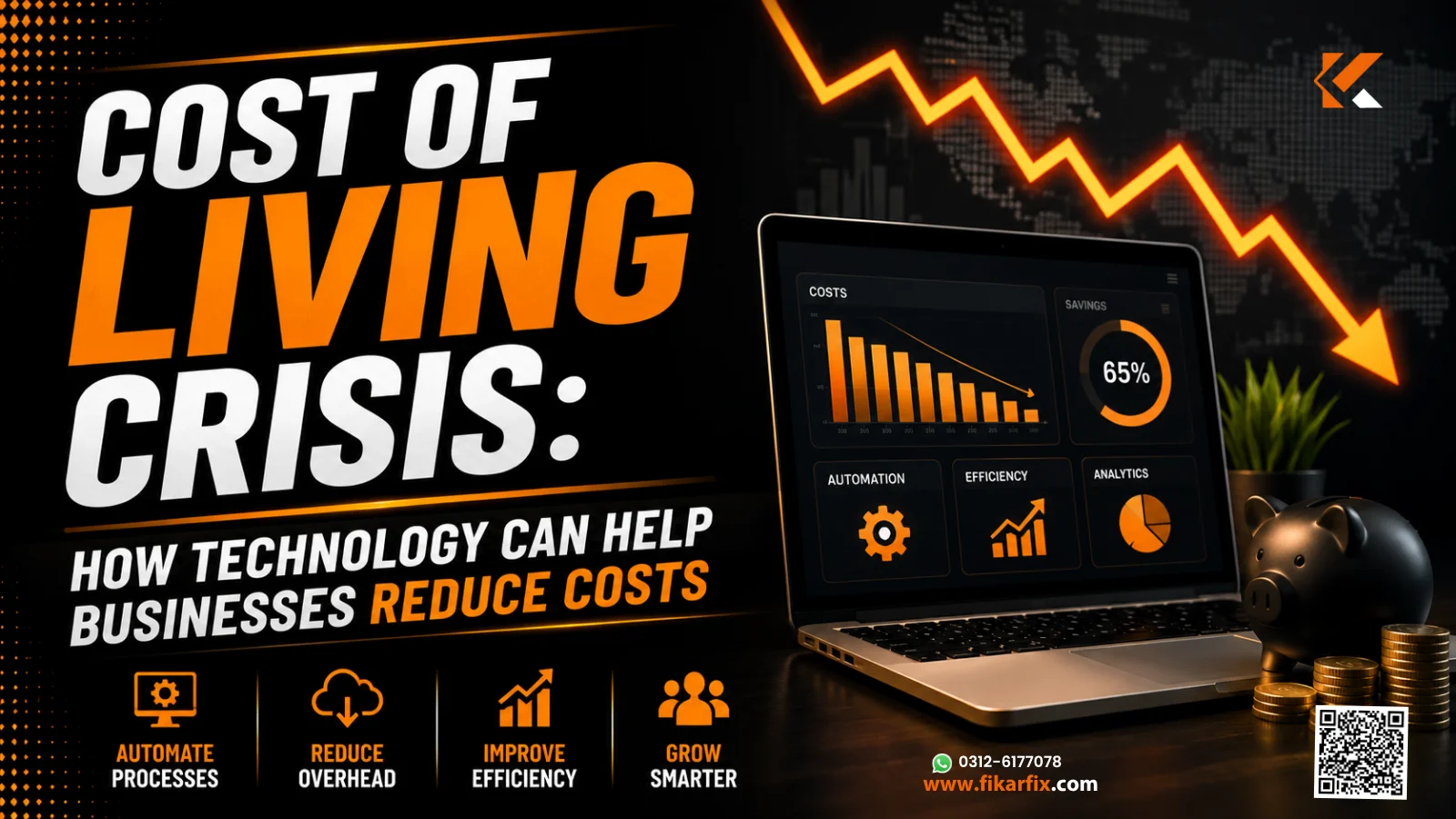
Cost of Living Crisis: How Technology Can Help Businesses Reduce Costs
Aug 16, 2026
AI Automation
34 views
Cost of Living Crisis: How Technology Can Help Businesses Reduce Costs
Umar Shahzad Nasir
The cost of living crisis is putting pressure on households and businesses across the UK and US.
For businesses, rising operating costs can affect almost everything—from staffing and office space to marketing, customer service, software, and day-to-day operations.
But there is another side to the challenge:
Technology can help businesses do more with less.
From AI automation and cloud solutions to digital marketing and smarter websites, businesses can use technology to reduce repetitive work, improve efficiency, and protect their profit margins.
At FikarFix, we believe technology shouldn't simply be an expense.
It should become a business advantage.
Why the Cost of Living Crisis Matters to Businesses
When customers are becoming more careful about spending, businesses face two challenges at the same time:
Costs are increasing.
Customers are becoming more selective.
This means businesses need to become more efficient while delivering greater value to customers.
For example, a small UK retailer paying for expensive office space, manual administration, traditional advertising, and multiple disconnected software systems may be spending significantly more than necessary.
The same principle applies to a growing US startup managing customer enquiries, social media, appointments, invoices, and reporting manually.
The solution isn't always to cut essential services.
Sometimes, the smarter solution is to automate and optimize them.
1. AI Automation Can Reduce Repetitive Work
One of the biggest opportunities for businesses today is AI automation.
Many everyday tasks consume valuable employee time:
- Answering repetitive customer questions
- Scheduling appointments
- Generating reports
- Organizing data
- Responding to basic enquiries
- Creating routine content
- Processing repetitive administrative tasks
AI-powered systems can help automate parts of these workflows.
Example: A UK Service Business
Imagine a London-based home-services company receiving dozens of enquiries every day.
Instead of having an employee manually answer every basic question, an AI-powered chatbot could handle common enquiries such as:
“What services do you offer?”
“Do you cover my area?”
“How can I request a quote?”
The team can then focus on customers who actually need human assistance.
The result?
Less repetitive work + faster responses + better use of staff time.
2. Remote & Cloud Technology Can Lower Overheads
Businesses don't always need expensive infrastructure to operate efficiently.
Cloud-based tools allow teams to collaborate, store information, manage projects, and communicate from almost anywhere.
For many businesses in the UK and US, this can support flexible and hybrid working models.
Instead of maintaining unnecessary physical infrastructure, businesses can use:
- Cloud storage
- Project management platforms
- Online communication tools
- Cloud-based accounting
- Digital document management
- Remote collaboration systems
The goal isn't simply to "work remotely."
The goal is to build a more flexible and efficient operation.
3. Your Website Can Work as a 24/7 Sales Assistant
A business website shouldn't just be an online brochure.
A well-designed website can answer questions, generate leads, collect enquiries, showcase services, and even process purchases.
Imagine a US consulting company receiving enquiries outside normal working hours.
A conversion-focused website could provide:
Services → Pricing Information → FAQs → Case Studies → Contact Form → Booking
Instead of requiring a team member to explain everything manually, the website handles much of the initial customer journey.
That's the power of a strategic website.
It works even when your team isn't available.
4. Digital Marketing Can Be More Efficient
During a cost-of-living crisis, businesses need to be careful about where they spend their marketing budget.
Traditional advertising can still have value, but digital marketing provides powerful opportunities to target specific audiences and measure performance.
Businesses can use:
SEO
to attract people actively searching for their products or services.
Social Media Marketing
to build awareness and engage potential customers.
Content Marketing
to educate audiences and build trust.
Email Marketing
to maintain relationships with existing customers.
Instead of simply asking:
"How much did we spend on marketing?"
businesses should ask:
“What did that marketing investment actually produce?”
5. SEO Can Create Long-Term Value
Paid advertising can bring immediate visibility, but SEO can help businesses build a long-term source of organic traffic.
Consider a US accounting firm targeting searches such as:
“small business accountant in New York”
or a UK business targeting:
“digital marketing agency in Manchester.”
If the business builds useful content, strong service pages, and a technically optimized website, it can continue attracting relevant visitors from search engines over time.
SEO isn't a shortcut.
It's an investment in long-term visibility.
Case Study: From Manual Work to Digital Workflow
Let's consider a simple hypothetical example.
Before
A growing UK e-commerce business manages:
- Customer enquiries manually
- Orders through multiple channels
- Social media posting manually
- Customer follow-ups through spreadsheets
- Basic reports created manually
The team is spending hours every week on repetitive tasks.
After Digital Transformation
The business introduces:
E-commerce Website
↓
Automated Order Management
↓
AI Customer Support
↓
Social Media Scheduling
↓
Automated Email Follow-ups
↓
Analytics Dashboard
Now employees can spend more time on:
Customers + Strategy + Product Development + Growth
The technology doesn't replace the team.
It helps the team work smarter.
What Businesses Should Automate First
Not every process needs AI.
The best starting point is usually repetitive work that:
- Happens frequently
- Follows predictable steps
- Takes significant employee time
- Doesn't require complex human judgment
- Can be measured easily
For example:
Customer FAQs → Automation
Appointment booking → Automation
Routine reporting → Automation
Basic data processing → Automation
Strategic decisions → Human expertise
This balance is important.
The FikarFix Perspective
At FikarFix, we don't believe businesses should adopt technology simply because it is trendy.
The right question is:
“Where can technology create the biggest business impact?”
That's why our approach combines technology with business objectives.
Depending on the business, this may include:
- AI Automation
- Web Development
- SEO
- Social Media Marketing
- UI/UX Design
- E-commerce Solutions
- Digital Content
- Business Workflow Optimization
A small business may need a better website.
A growing company may need automation.
An e-commerce brand may need SEO and conversion optimization.
A startup may need an entire digital ecosystem.
The solution should fit the problem.
Technology Should Reduce Friction—Not Add It
The cost of living crisis creates pressure.
But pressure can also encourage businesses to rethink how they operate.
Instead of simply asking:
“Where can we cut costs?”
business leaders should also ask:
“Where are we wasting time?”
“What can be automated?”
“What processes can be simplified?”
“Can our website generate more leads?”
“Are we spending marketing money efficiently?”
“Can technology help our team focus on higher-value work?”
These questions can lead to much smarter decisions.
Final Takeaway
The cost of living crisis is challenging businesses across the UK and US, but technology can provide practical ways to respond.
AI can automate repetitive work.
Cloud tools can improve flexibility.
Websites can generate leads 24/7.
SEO can build long-term visibility.
Digital marketing can make customer acquisition more measurable.
The goal isn't to use technology everywhere.
The goal is to use the right technology in the right place.
Because when technology reduces unnecessary work, improves customer experience, and helps businesses make better decisions, it becomes more than a cost.
It becomes an investment in growth.
Ready to Make Your Business More Efficient?
At FikarFix, we help businesses turn digital challenges into practical solutions through web development, SEO, social media marketing, UI/UX design, AI automation, and digital strategy.
Your business shouldn't just survive changing times.
It should be built to adapt.
FikarFix — Think. We Fix.
Have a digital process that is costing you time or money? Let's find a smarter way to fix it.
Recent Posts
-
Boost Hostel Operations with a Smart Management Platform
Sep 25, 2026
-
YouTube SEO for Urdu Videos: Titles, Descriptions, Chapters and Subtitles
Sep 21, 2026
-
GPT-6 Astra vs Claude Fable 5.1: Which AI Model Fits Your Work?
Sep 20, 2026
-
GPT-6 Astra Features: AI That Moves From Ideas to Action
Sep 16, 2026
FikarFix
Ask about the company & projects
Hi, I am the FikarFix assistant. Ask me about the company, our services, or recent projects.