
FikarFix...
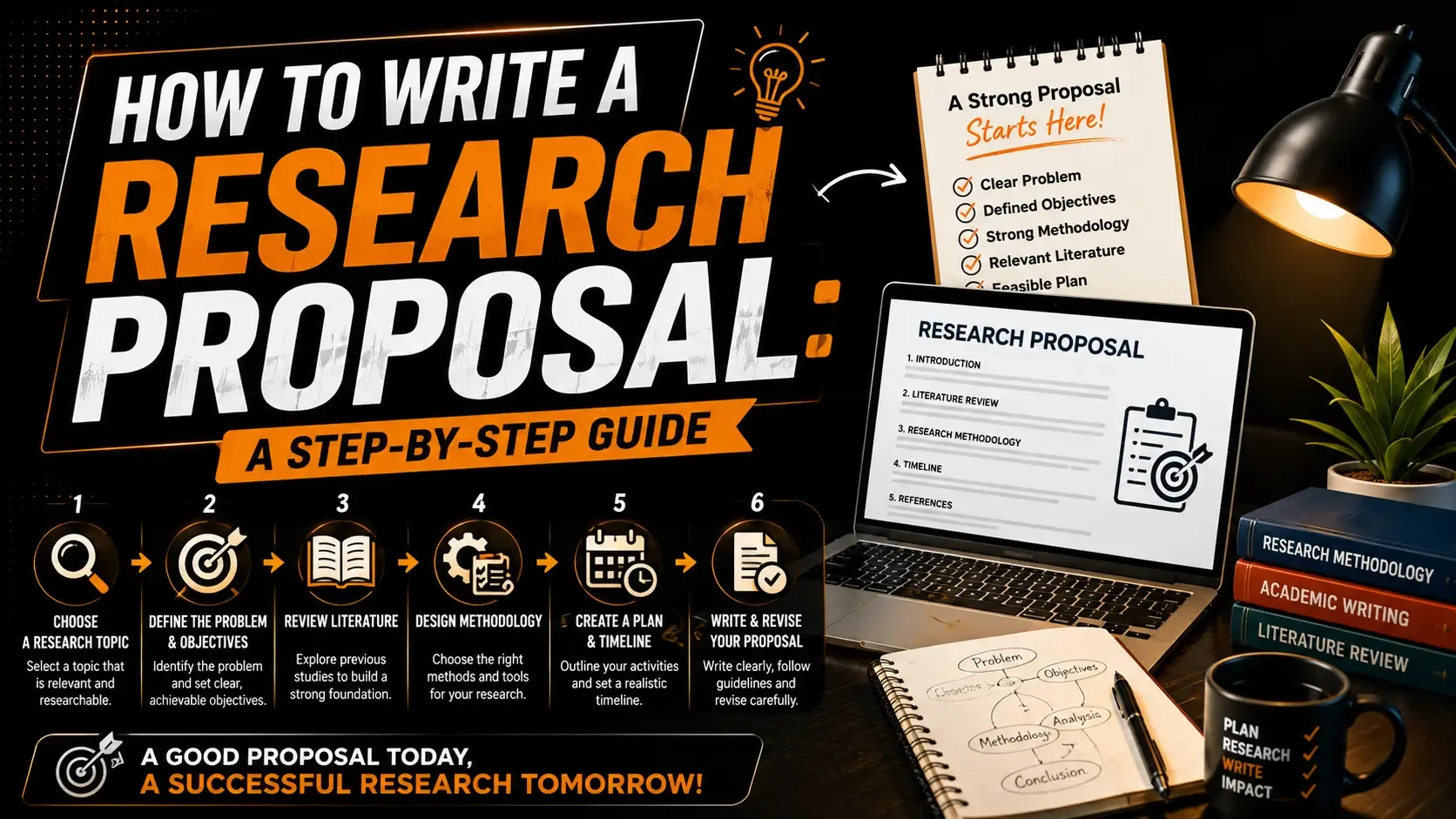
How to Write a Research Proposal: A Step-by-Step Guide
Aug 31, 2026
Ethical Academic Research
31 views
How to Write a Research Proposal: A Step-by-Step Guide
Why Does a Research Proposal Matter?
Umar Shahzad Nasir
A research proposal is more than a formal academic document. It is a roadmap for your research idea.
Whether you are a university student preparing a thesis, a researcher applying for funding, or a professional proposing a research project, a strong proposal helps readers quickly understand:
- What you want to research
- Why the topic matters
- How you will conduct the research
- What outcomes you expect
A weak proposal can make a good research idea difficult to understand. A well-structured proposal can turn that same idea into a convincing research plan.

1. Start With a Clear Research Problem
Every strong research proposal begins with a clear problem.
Instead of choosing a broad topic such as:
"Artificial Intelligence in Education"
narrow it down to a researchable problem:
"How does AI-assisted learning affect student engagement in online university courses?"
The second topic gives you something specific to investigate.
Quick Example
Too broad:
Social Media and Businesses

Better:
The Impact of Short-Form Video Content on Customer Engagement Among Small Businesses
Even better:
How Short-Form Video Content Influences Customer Engagement for Small E-Commerce Brands
2. Create a Strong Research Title
Your title should tell the reader exactly what the research is about without becoming unnecessarily complicated.
A useful formula is:
Topic + Key Variable + Target Group/Context
Example
Instead of:
"Technology and Education"
Try:
"The Impact of AI-Powered Learning Tools on Student Engagement in Online Education"
The second title immediately communicates the research direction.
3. Write an Effective Abstract
The abstract is often the first section reviewers read, so it needs to communicate your idea quickly.
A good abstract normally introduces:
Problem → Purpose → Method → Expected Outcome
Think of it as the elevator pitch for your research.
Example Structure
This study examines how AI-powered learning tools influence student engagement in online education. Using a mixed-method research design, the study will collect quantitative and qualitative data from online learners. The findings are expected to provide insights into how AI can be integrated into digital learning environments more effectively.
Keep it focused. The abstract is not the place to explain every detail.
4. Build a Strong Literature Review
A research proposal should demonstrate that you understand what has already been studied.
Don't simply list articles one after another.
Instead, identify:
- What researchers already know
- Where researchers disagree
- What remains unexplored
- Where your research fits
Simple Example
Imagine several studies have examined AI tutoring systems.

Study A → AI improves personalized learning
Study B → AI increases student engagement
Study C → Students have concerns about AI accuracy
Your research opportunity might be:
"There is limited research examining both engagement and trust in AI-powered learning environments."
That gap can become the foundation of your research.
5. Define Your Research Objectives
Your objectives explain what your research will accomplish.
Weak objective:
To study AI in education.
Stronger objectives:
- To examine the use of AI learning tools among university students.
- To evaluate their impact on student engagement.
- To identify challenges associated with AI-assisted learning.
- To develop recommendations for effective implementation.
A useful test is:
Can someone measure whether this objective has been achieved?
If yes, your objective is probably specific enough.
6. Choose the Right Methodology
This is one of the most important sections of your proposal.
Your methodology explains how you will answer your research question.
Depending on your research, you might use:
| Research Approach | Useful For |
|---|---|
| Qualitative | Experiences, opinions, perceptions |
| Quantitative | Numbers, relationships, statistical analysis |
| Mixed Methods | Combining qualitative + quantitative evidence |
| Case Study | Detailed investigation of a specific case |
| Experimental | Testing cause-and-effect relationships |
Example
Research Question:
Does AI-assisted learning improve student engagement?

Possible methodology:
Participants → University Students
Data Collection → Survey + Interviews
Analysis → Statistical Analysis + Thematic Analysis
Outcome → Evidence-based conclusions
7. Create a Realistic Research Timeline
A good proposal should demonstrate that your project is realistic and achievable.
For example:
Month 1: Literature Review
↓
Month 2: Research Design
↓
Month 3: Data Collection
↓
Month 4: Data Analysis
↓
Month 5: Findings & Discussion
↓
Month 6: Final Report
A simple timeline makes a complicated research project much easier to understand.
8. Prepare the Budget
If your proposal requires funding, explain where the money will be used.
Typical categories may include:
- Research materials
- Software
- Data collection
- Participant costs
- Travel
- Equipment
- Research assistance
- Publication expenses
The key is justification.
Don't simply write:
Research Expenses — $5,000
Explain what the money will actually support.
Mini Case Study: Turning an Idea Into a Proposal
The Initial Idea
A student wants to research:
"AI and Students"
That's interesting—but too broad.
Step 1 — Research Problem
Students are increasingly using AI tools, but their influence on learning engagement remains unclear.
Step 2 — Research Question
How does AI-assisted learning influence student engagement in online education?
Step 3 — Objectives
- Examine AI usage patterns.
- Measure student engagement.
- Identify benefits and challenges.
- Develop recommendations.
Step 4 — Methodology
Survey + Interviews + Data Analysis
Now the original idea has become a structured, researchable proposal.

Common Research Proposal Mistakes
Even strong research ideas can lose their impact because of poor presentation.
Avoid These Mistakes
❌ Research question is too broad
❌ Objectives don't match the research problem
❌ Literature review only summarizes sources
❌ Methodology lacks detail
❌ Timeline is unrealistic
❌ References are inconsistent
❌ Too much jargon
❌ Poor grammar and formatting
A proposal should be clear, focused, evidence-based, and realistic.
Final Research Proposal Checklist
Before submission, ask:
☑ Is my research problem clearly defined?
☑ Does my title match my research question?
☑ Are my objectives specific and measurable?
☑ Does my literature review identify a research gap?
☑ Is my methodology appropriate?
☑ Is my timeline realistic?
☑ Is my budget justified?
☑ Are my references correctly formatted?
☑ Have I proofread the complete document?
The FikarFix Perspective
A great research idea deserves more than good writing—it needs clear structure, strong evidence, and a logical research strategy.
At FikarFix, our Research & Academic Writing services can support students, researchers, professionals, and organizations with research proposals, literature reviews, academic editing, referencing, and research documentation.
Your idea. Our expertise. A stronger research proposal.
FikarFix — Think we Fix.

Ready to Build Your Research Proposal?
Don't let a great research idea get lost in a poorly structured proposal. Let FikarFix help you transform your concept into a clear, professional, and research-ready proposal.
Get in touch with FikarFix today for a consultation.
Recent Posts
-
Smart School Management System: Simplify School Operations with Digital Solutions
Oct 15, 2026
-
Boost Hostel Operations with a Smart Management Platform
Sep 25, 2026
-
YouTube SEO for Urdu Videos: Titles, Descriptions, Chapters and Subtitles
Sep 21, 2026
-
GPT-6 Astra vs Claude Fable 5.1: Which AI Model Fits Your Work?
Sep 20, 2026
FikarFix
Ask about the company & projects
Hi, I am the FikarFix assistant. Ask me about the company, our services, or recent projects.