
FikarFix...
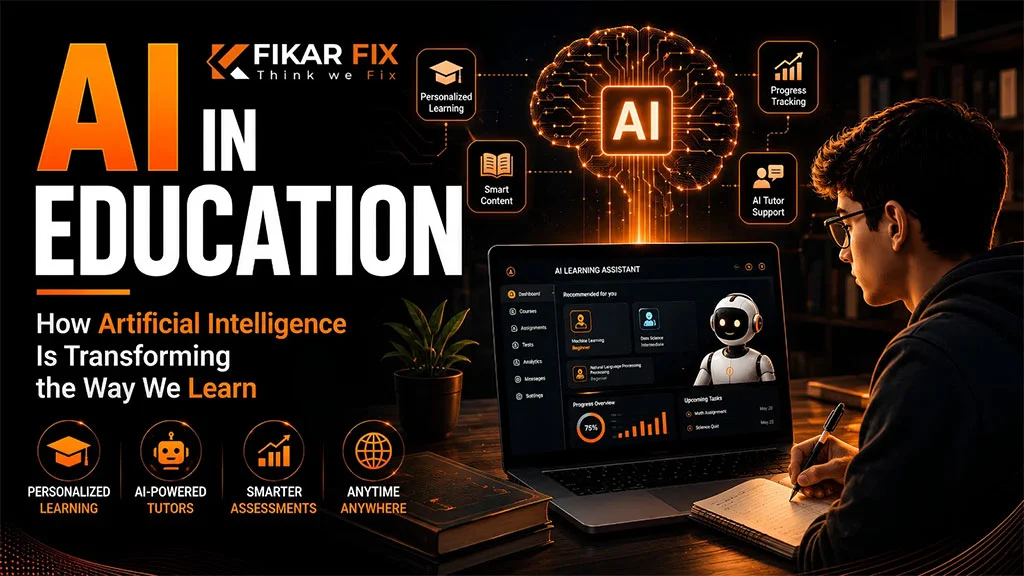
AI in Education: How Artificial Intelligence Is Transforming the Way We Learn
Jul 31, 2026
AI Automation
89 views
AI in Education: How Artificial Intelligence Is Transforming the Way We Learn
From Traditional Classrooms to Intelligent Learning Experiences
Abdul Qadir
Imagine a student struggling with a difficult concept.
The teacher has already explained it twice, but the student is still confused.
In a traditional classroom, the teacher may not have enough time to explain the same concept individually five or ten times.
Now imagine an intelligent learning system that notices the student's difficulty, identifies the topic they are struggling with, changes the explanation, provides additional examples, and gives instant feedback.
That's where Artificial Intelligence in Education becomes powerful.
AI isn't here to replace teachers.
It can help teachers understand their students better, reduce repetitive work, and create learning experiences that adapt to individual needs.
At FikarFix, we see the future of education as a collaboration between human expertise, intelligent technology, and personalised learning.
What Is AI in Education?
AI in education refers to using artificial intelligence technologies to improve teaching, learning, assessment, administration, and student support.
AI-powered education systems can analyse learning behaviour, identify patterns, automate repetitive tasks, and provide personalised recommendations.
Depending on the educational environment, AI can be used for:
- Personalised learning
- Intelligent tutoring
- Automated assessments
- Student support
- Content recommendations
- Learning analytics
- Administrative automation
- Online education
- Virtual classrooms
- Educational chatbots
The goal isn't simply to "add AI" to education.
The real goal is to use AI to solve educational problems.
Why Personalised Learning Matters
Every student learns differently.
One student may understand a concept after reading a short explanation.
Another may need a visual example.
Someone else may learn better through practice questions.
Traditional teaching often has to follow one pace for an entire classroom.
AI can help create a more personalised experience.
For example:
Umar : Needs additional beginner-level explanations.
Fatima: Understands the concept and needs advanced questions.
Ali Makes repeated mistakes and needs targeted practice.
An AI-powered platform can identify these differences and recommend appropriate learning material.
Real-Life Example
Consider an online mathematics course.
A student completes ten questions on algebra.
The system notices that the student repeatedly makes mistakes when solving equations with variables on both sides.
Instead of simply showing:
"Incorrect."
An intelligent learning system could:
- Identify the weak concept.
- Explain the underlying rule.
- Provide a simpler example.
- Give another practice question.
- Increase the difficulty gradually.
This creates a learning loop:
Learn → Practice → Analyse → Improve → Repeat
That's the real potential of AI-powered education.
Case Study 1: When One Learning Path Wasn't Enough
The Challenge
An online education platform noticed that students were progressing at very different speeds.
Some completed lessons quickly, while others repeatedly revisited the same topics.
The platform was using the same learning sequence for everyone.
As a result, advanced students became disengaged while struggling students needed additional support.
The Solution
An AI-assisted learning system was introduced to analyse:
- Quiz performance
- Lesson completion
- Repeated mistakes
- Learning pace
- Topic engagement
Based on these signals, the system recommended different learning materials to different students.
The Result
Students were no longer forced into exactly the same learning path.
Advanced learners could move forward, while students who needed additional support received targeted resources.
Key Lesson
Personalisation doesn't mean creating a separate course for every student.
AI can help create different learning experiences from the same educational ecosystem.
AI-Powered Tutoring
One of the most exciting applications of AI in education is intelligent tutoring.
An AI tutor can help students:
- Ask questions
- Review concepts
- Practise problems
- Receive instant explanations
- Get feedback
- Explore additional examples
Imagine a student studying late at night and getting stuck on a difficult concept.
Instead of waiting until the next class, an AI tutor could provide immediate assistance.
However, there is an important distinction:
AI tutoring should support education—not replace qualified teachers.
Teachers provide context, mentorship, emotional support, ethical guidance, and human understanding that technology cannot fully replicate.
AI Can Help Teachers Too
AI in education isn't only about students.
Teachers can benefit enormously from intelligent tools.
AI can help with:
- Creating lesson plans
- Generating practice questions
- Preparing quizzes
- Analysing student performance
- Organising learning material
- Summarising student feedback
- Automating routine administrative work
This can allow teachers to spend more time doing what matters most:
Teaching, mentoring, and connecting with students.
Case Study 2: Giving Teachers More Time to Teach
The Challenge
A learning organisation's instructors were spending significant amounts of time preparing repetitive quizzes, organising learning materials, and reviewing basic student performance data.
This administrative workload reduced the time available for student interaction.
The Solution
An AI-assisted workflow was introduced.
The system helped:
- Generate question banks
- Organise course content
- Categorise student performance
- Identify students needing additional support
- Prepare basic progress summaries
Teachers remained responsible for reviewing and approving the material.
The Result
Instead of replacing educators, technology reduced repetitive workload and allowed instructors to focus more on teaching and mentoring.
Key Lesson
The best educational AI systems don't remove teachers from the process—they give teachers better tools.
AI Chatbots for Student Support
Students often have simple questions:
- Where can I find this lesson?
- When is the assignment due?
- How do I reset my password?
- Which module should I study next?
- Where can I download the course material?
Answering these questions manually can consume significant staff time.
An AI-powered educational chatbot can handle many routine queries instantly.
For example:
Student: Where can I find Lesson 5?
AI Assistant: You can find Lesson 5 under Module 2 → Week 3. Would you like me to open the lesson?
This creates a faster and more convenient learning experience.
AI-Powered Learning Management Systems
A modern Learning Management System (LMS) can become much more powerful when combined with AI.
An AI-enhanced LMS can potentially provide:
- Student Dashboard
- Intelligent Progress Tracking
- Automated Assessments
- Smart Recommendations
- AI Student Assistant
- Teacher Analytics
Beyond Text: AI + Immersive Learning
Education doesn't have to be limited to text and videos.
AI can work alongside emerging technologies such as:
- Virtual Reality
- Augmented Reality
- Interactive simulations
- Voice assistants
- Computer vision
Imagine learning science through an interactive virtual laboratory rather than simply reading about an experiment.
Or studying history through an immersive digital environment.
The combination of AI and immersive technology can make complex concepts more interactive and memorable.
AI in Online Quran & Islamic Education
AI can also support online religious education when used responsibly and under qualified human supervision.
For example, an online learning platform could use technology to support:
- Lesson recommendations
- Revision schedules
- Vocabulary practice
- Arabic language exercises
- Memorisation tracking
- Student progress dashboards
- Routine learning reminders
However, religious knowledge requires particular care.
AI should not be treated as an independent authority for religious rulings or scholarly interpretation.
Qualified teachers and scholars should remain central to the learning process.
The Challenges of AI in Education
AI offers enormous opportunities, but implementation must be responsible.
1. Data Privacy
Educational platforms may handle sensitive student information.
Institutions need appropriate policies for collecting, storing, and using data.
2. Accuracy
AI systems can sometimes generate incorrect or misleading information.
That's why educational AI should include human review and reliable source verification.
3. Bias
AI systems can reflect biases present in their training data.
Educational institutions should evaluate AI systems carefully to ensure fair treatment of learners.
4. Digital Accessibility
Not every learner has the same access to devices, connectivity, or digital resources.
AI-powered education should be designed with accessibility in mind.
5. Teacher Training
Technology alone cannot transform education.
Teachers need training and support to understand how AI tools work and when they should—or should not—be used.
The Human + AI Model
The most effective educational model isn't:
AI vs Teacher
It is:
AI + Teacher + Student
AI handles:
Data + Automation + Personalisation + Recommendations
Teachers provide:
Experience + Mentorship + Context + Human Judgement
Students receive:
Better Support + Flexibility + Personalised Learning
This creates a much stronger educational ecosystem.
FikarFix's Approach to AI in Education
At FikarFix, we believe technology should solve real problems rather than simply follow trends.
Our approach combines:
01 — Understand
We identify the educational institution's or organisation's actual challenges.
02 — Design
We design a user-friendly learning experience around students and teachers.
03 — Integrate AI
We introduce AI where it can create measurable value.
04 — Human Oversight
We keep educators and administrators involved in important decisions.
05 — Improve
We analyse performance and continuously improve the system.
This approach allows technology to work with educators rather than against them.
What Can FikarFix Build?
Depending on your requirements, AI can be integrated into:
- Learning Management Systems
- Online Course Platforms
- Virtual Classrooms
- AI Educational Chatbots
- Student Support Systems
- Learning Analytics Dashboards
- Personalised Learning Platforms
- Online Assessment Systems
- Course Recommendation Engines
- Educational Automation Workflows
Whether you're building a new education platform or improving an existing one, the right technology strategy can make a significant difference.
Expert Insight
AI should not make education less human. It should give educators more time to be human.
The real success of AI in education won't be measured by how much technology we introduce.
It will be measured by whether students learn better, teachers work smarter, and educational organisations serve their learners more effectively.
7 Practical Ways to Start Using AI in Education
You don't need to transform your entire educational system overnight.
Start small.
1. AI Student Support
Automate routine questions and guidance.
2. Personalised Recommendations
Recommend lessons based on student performance.
3. Automated Quiz Generation
Create practice questions to support revision.
4. Learning Analytics
Identify students who may need additional support.
5. Content Assistance
Help teachers prepare educational resources.
6. Administrative Automation
Reduce repetitive tasks.
7. AI-Powered LMS
Bring multiple intelligent features together in one platform.
Frequently Asked Questions
Can AI replace teachers?
AI can automate certain tasks, but teachers provide mentorship, emotional intelligence, context, and professional judgement. The strongest model is collaboration between AI and educators.
Is AI suitable for online education?
Yes. AI can enhance personalisation, student support, assessment, analytics, and course recommendations.
Can AI create an LMS?
AI can assist with development and automation, but building a professional LMS requires software development, UX design, security, database architecture, and ongoing maintenance.
Can AI help students learn faster?
It can provide personalised explanations, immediate feedback, targeted practice, and learning recommendations. Results depend on how the system is designed and used.
Should students rely completely on AI?
No. Students should use AI as a learning assistant while developing their own critical thinking, research, and problem-solving skills.
The Future of Education Is Intelligent—and Human
Education is entering a new era.
The question is no longer whether AI will influence education.
It already is.
The real question is:
How intelligently will we use it?
AI can analyse.
AI can recommend.
AI can automate.
AI can personalise.
But education still needs something technology cannot fully reproduce:
Human connection.
The future belongs to educational systems that combine the efficiency of artificial intelligence with the experience, empathy, and wisdom of educators.
Ready to Build a Smarter Learning Experience?
Whether you're planning an online academy, upgrading an LMS, launching virtual classes, or exploring AI automation for education, FikarFix can help turn your idea into a practical digital solution.
Our expertise combines:
AI Automation + Web Development + UI/UX + eLearning + Digital Strategy
We don't simply add AI because it's trending.
We use it where it creates real value.
Let's build the future of learning—together.
Think. We Fix.